
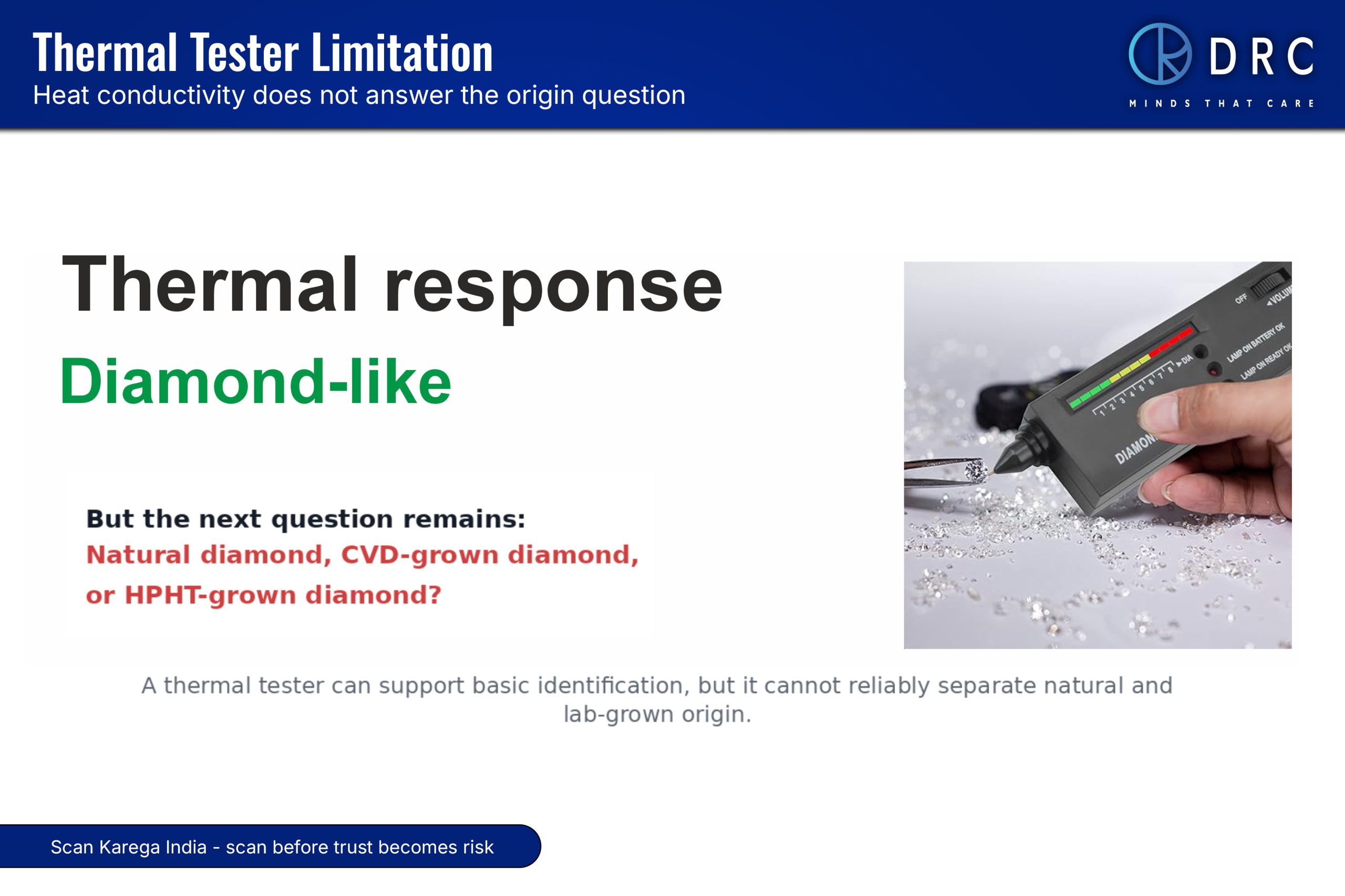
 A thermal diamond tester is one of the most common tools used at jewellery counters. It is quick, easy to carry and simple to use. But in today’s diamond market, a thermal tester alone is not enough.
Jewellers are no longer checking only whether a stone behaves like a diamond. They are also dealing with CVD-grown diamonds, HPHT-grown diamonds, CZ, moissanite-risk checks, mounted jewellery, loose parcels, customer exchange jewellery and supplier stock. This changes the question completely. The question is not only: is this stone diamond-like? The real question is: is this stone natural, laboratory-grown, simulant-risk, or something that needs deeper verification?
What is a Thermal Diamond Tester?
A thermal diamond tester is a handheld device that checks how heat passes through a stone. Diamonds conduct heat differently from many other materials, so thermal conductivity can help in some basic testing situations.
But thermal testing was never designed to answer every modern diamond verification question. It may help in a first-level check, but it cannot become the final protection layer for jewellers dealing with laboratory-grown diamond risks and simulants.
The Main Limitation
The most important point is simple: a lab-grown diamond is still diamond material. Because natural diamonds and lab-grown diamonds share many essential physical properties, heat conductivity alone cannot reliably separate natural origin from CVD-grown or HPHT-grown origin.
A thermal tester may answer whether the stone behaves like diamond in a basic way. It cannot reliably answer whether the stone is natural, CVD-grown or HPHT-grown.
Why Lab-Grown Diamond Detection Needs More Than Heat Testing
CVD-grown and HPHT-grown diamonds are laboratory-grown diamonds. They are not naturally mined. Because their appearance can be very close to natural diamonds, jewellers need more than a heat-based check. A laboratory-grown diamond may pass certain basic tester responses but still require proper screening for origin and disclosure.
The practical risk is simple: a stone may look fine, a tester may respond confidently, but the business may still not have enough information.
Where Jewellers Face the Biggest Risk
Thermal testing becomes especially limited in real retail situations: customer old jewellery for exchange, rings with multiple mounted stones, bangles with many small diamonds, loose parcels from suppliers, mixed stock lots, high-value jewellery sales, certification-ready items and inventory received from multiple vendors.
In these cases, the jeweller is not just checking one loose stone in ideal conditions. The jeweller is making a business decision. Business decisions need stronger verification.
How DRC Helps Jewellers Move Beyond Thermal Testing
DRC’s diamond detection ecosystem is designed for jewellers, traders, exporters, sourcing offices and manufacturers who need more than basic handheld checking. Depending on the use case, DRC’s detection range includes J Mini Pro, Sentinel, Guardian, J Detect Pro and J Smart Pro.
The right machine depends on the store’s real workflow: jewellery format, scanning area, daily volume, team usability and reporting expectations. This is the practical meaning of Scan Karega India: do not stop at a beep; build a scan-first workflow.
Final Thought
A thermal tester checks one signal. A detection machine supports a decision. For modern jewellers dealing with natural diamonds, CVD, HPHT, CZ and mounted jewellery risks, a scan-first workflow is stronger than assumption-based checking.