
 A jeweller does not lose trust only when something goes wrong. Sometimes, trust is lost when the customer feels that the jeweller did not check enough. With the rise of CVD-grown diamonds, HPHT-grown diamonds, CZ, moissanite and other simulant risks, jewellery businesses can no longer depend only on supplier trust, staff experience or basic tester pens.
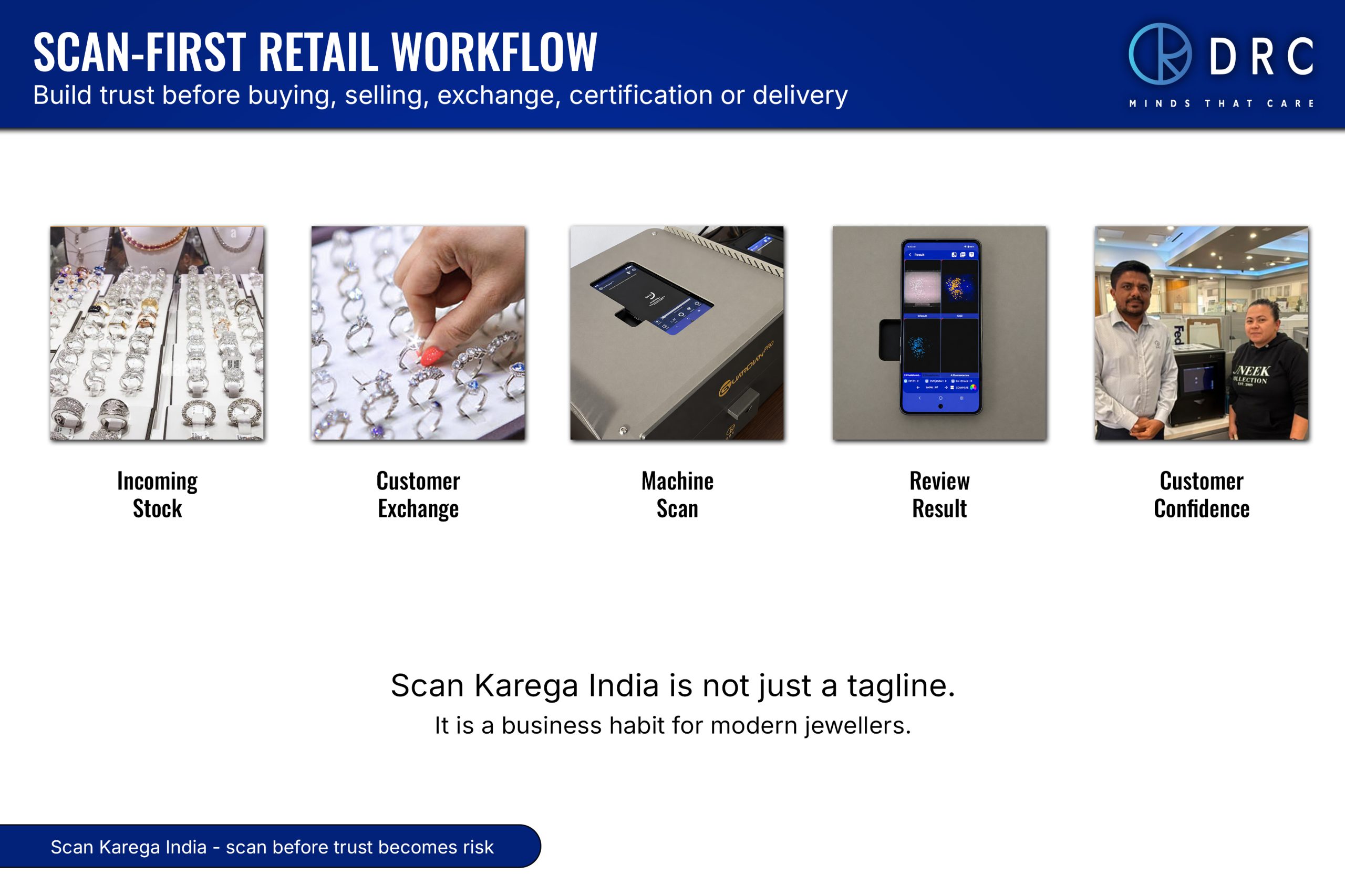
Today, every jeweller needs a lab-grown diamond detection machine not because customers doubt jewellers, but because the jewellery business itself has become more complex. A diamond may come from a supplier, customer exchange, old inventory, repair order, resale jewellery, loose parcel or mounted jewellery piece. In every case, the question is the same: has this diamond been scanned before the business decision was made? That is the belief behind Scan Karega India.
The New Risk for Jewellers
Earlier, many jewellers depended on experience and supplier relationships. That is still important. But the market has changed. Today, a jeweller may deal with natural diamond jewellery, CVD-grown diamonds, HPHT-grown diamonds, CZ and simulant risks, moissanite confusion, mounted jewellery, loose diamond parcels, customer exchange jewellery and old inventory from multiple sources.
In this environment, even an honest jeweller can face risk if the checking process is weak. The problem is not only fraud. The bigger problem is undetected mixing.
Why Experience Alone is Not Enough
Experience matters in jewellery, but experience should be supported by technology. A trained jeweller may understand diamond appearance, brilliance, setting, pricing and customer behaviour. But CVD and HPHT-grown stones may not always reveal themselves through normal visual inspection.
A basic diamond tester pen may help in limited cases, but it cannot become the final protection layer for every situation. Jewellers need machine-led screening especially when checking rings, bangles, bracelets, necklaces, loose diamonds, melee parcels, customer exchange jewellery, supplier stock and high-value purchases.
How a Detection Machine Protects a Jewellery Business
A lab-grown diamond detection machine is not just a testing device. It protects the business at multiple points. Before buying, scanning helps verify supplier stock before payment decisions. Before selling, scanning adds another layer of confidence. Before exchange, scanning helps reduce unknown-history risk. Before certification, screening avoids surprises later. Before delivery, a final scan supports trust, transparency and internal discipline.
This is the practical meaning of Scan Karega India: scan before every important diamond decision.
DRC Solutions for Different Jeweller Needs
Every jewellery business does not need the same machine. A small boutique store, retail chain, sourcing office, exporter and manufacturer all have different scanning needs. DRC’s detection range includes J Mini Pro for compact store-level screening, Sentinel for retail-focused scanning with larger area, Guardian for bigger jewellery pieces and higher daily volume, J Detect Pro for professional users and loose diamond workflows, and J Smart Pro for exporters, sourcing offices and high-volume jewellery businesses.
The selection should depend on the jeweller’s actual workflow: jewellery format, scanning area, daily volume, reporting needs and team usability.
Why This is Also a Customer Trust Tool
Customers may not understand the full technical difference between CVD, HPHT, CZ and moissanite. But customers understand one thing clearly: did you check properly? A jeweller with a scan-first process can answer with more confidence. It improves the conversation around natural diamond disclosure, lab-grown diamond risk, exchange valuation, certification readiness, customer delivery and supplier accountability.
Final Thought
Every jeweller does not need a lab-grown diamond detection machine because they are suspicious. They need it because they are responsible – responsible for customer trust, correct disclosure, supplier verification, exchange decisions and brand reputation.