
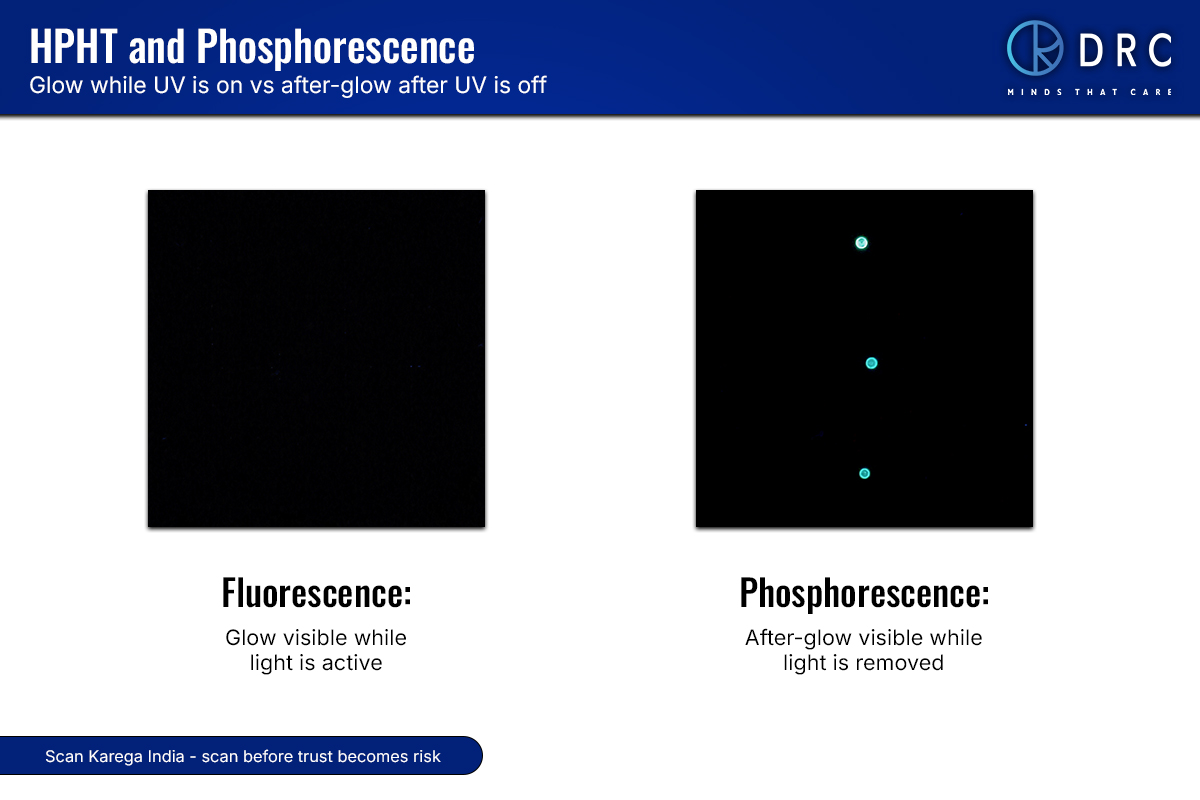
 In diamond testing, some stones do not just react to light. They remember it for a few seconds. That after-glow is called phosphorescence, and it is one of the reasons HPHT diamond detection has become an important subject for jewellers, traders and manufacturers.
An HPHT diamond is a laboratory-grown diamond created through the High Pressure High Temperature process. It is not naturally mined. Because HPHT-grown diamonds can look extremely close to natural diamonds in normal viewing conditions, retailers cannot depend only on eyesight, experience or a basic diamond tester pen. For DRC India, this is where science meets everyday retail risk. Scan Karega India means every important diamond decision should be supported by a proper scan.
What Does HPHT Mean?
HPHT stands for High Pressure High Temperature. This process uses controlled laboratory conditions that recreate the pressure and temperature environment required for diamond growth. The result is an HPHT-grown diamond, not a naturally mined diamond.
For a jeweller, the key point is not only how HPHT is created. The key point is how it behaves during testing. HPHT-grown diamonds can show certain optical responses under specific light conditions. One of the most discussed responses is phosphorescence.
What is Phosphorescence in Diamond Testing?
Phosphorescence means a stone continues to glow briefly even after the light source has been removed. A simple way to understand it is this: fluorescence is the glow while the UV light is on. Phosphorescence is the glow after the UV light is off.
In many screening situations, phosphorescence may become a useful warning signal. Some HPHT-grown diamonds may show visible blue, greenish or blue-green after-glow under specific ultraviolet testing conditions. However, the jeweller should not treat every glow as a final answer. Not every HPHT-grown diamond behaves exactly the same way, and exceptions can exist. That is why phosphorescence should be read as part of a broader machine-led screening workflow.
Why Does an HPHT Diamond Show Phosphorescence?
The phosphorescence response is connected to atomic-level features inside the stone. When the diamond is exposed to a specific light source, some energy may be absorbed and then released slowly. That delayed release appears as temporary after-glow.
For jewellers, this matters because phosphorescence can act like a warning signal: this stone needs proper screening before it moves ahead. Manual observation can be affected by room light, stone size, jewellery setting, viewing angle, operator experience and testing conditions. A professional diamond detection machine helps make the observation more controlled and more repeatable.
Where Jewellers Face the Real HPHT Risk
The biggest challenge is not one loose stone kept neatly on a tray. The real risk appears in daily jewellery operations: customer exchange jewellery, mixed supplier parcels, rings with multiple mounted stones, bangles with many small diamonds, stock from multiple vendors and goods moving for certification or export.
In these cases, asking staff to depend only on visual checking is not practical. The real question for retailers is: can my team scan before the stone becomes a business problem?
DRC’s HPHT Detection Workflow
DRC’s detection ecosystem helps jewellers build a scan-first process for HPHT, CVD, CZ and related diamond risks. J Mini Pro, Sentinel, Guardian, J Detect Pro and J Smart Pro can be selected based on scanning area, jewellery format, daily volume, reporting needs and team usability.
The objective is not only to identify HPHT-grown diamonds. The objective is to create a repeatable scan-first workflow before purchase, exchange, certification, dispatch or customer delivery. That is the practical meaning of Scan Karega India: scan before doubt becomes dispute.
Final Thought
Phosphorescence is not just a glow. For jewellers, it can become a business signal. It may indicate that a stone needs deeper screening before buying, selling, exchanging, certifying or delivering. In a market where customer trust is everything, a scan-first process gives the jeweller stronger confidence than assumption-based checking.