
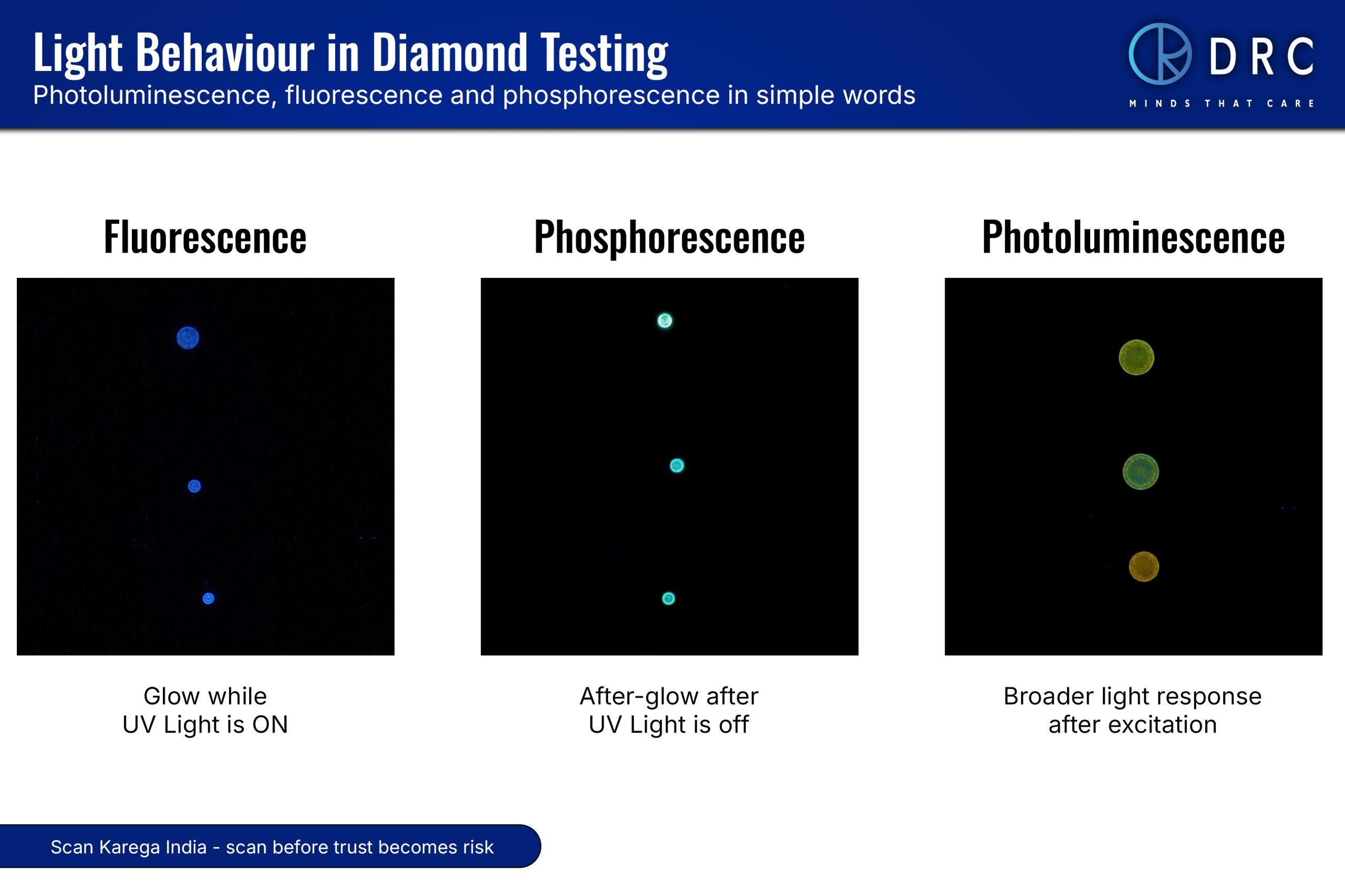
In diamond testing, light can reveal what the eye may miss.

A stone may look normal under showroom lighting, but under the right testing environment, it may respond differently. Sometimes it emits light while being exposed to a source. Sometimes it continues glowing even after the source is removed.

This is where two important terms come in:

Photoluminescence and phosphorescence.

For jewellers, traders and manufacturers, these are not just scientific words. They are part of the modern diamond screening language used to understand natural diamonds, CVD-grown diamonds, HPHT-grown diamonds, CZ, moissanite and other diamond-related risks.

From Katargam, Surat, one of India’s most active diamond manufacturing and jewellery technology hubs, DRC India — Diamtech Research Centre builds diamond detection solutions that help jewellers convert complex testing behaviour into practical screening workflows.

This is the belief behind Scan Karega India:

A movement to encourage every jeweller, manufacturer and diamond business to scan before they trust, buy, sell, exchange or certify.

Why Light Behaviour Matters in Diamond Testing

Jewellers should not judge a diamond only by how it looks under normal light.

In professional screening, the way a stone responds to specific light conditions can help identify whether it needs further verification. This becomes especially important when dealing with:

  • CVD-grown diamonds
  • HPHT-grown diamonds
  • Mounted jewellery
  • Loose diamond parcels
  • Melee diamonds
  • Customer exchange jewellery
  • CZ or moissanite-risk checks

Jewellers should not treat light behaviour alone as the final conclusion. But it can become an important signal inside a structured diamond detection workflow.

For jewellers, the real value is not in memorising scientific terms. The value is in knowing when a stone needs to be scanned properly before a business decision is made.

What is Photoluminescence in Diamond Testing?

Photoluminescence is a broad term.

It refers to the light emitted by a material after it absorbs energy from another light source. In diamond testing, photoluminescence can help reveal certain optical responses that may support identification, screening or further investigation.

A simple way to understand it:

Photoluminescence is the stone’s light response after being excited by a specific light source.

Advanced instruments and controlled testing conditions can study this response.

For jewellers, photoluminescence matters because it can help separate routine visual checking from more serious diamond screening. It is especially relevant when the stone’s origin or identity is not clear through basic inspection.

What is Phosphorescence in Diamond Testing?

Phosphorescence is a specific type of light response where the stone continues to glow briefly even after the light source has been removed.

A simple way to understand it:

Phosphorescence is the after-glow.

Experts often discuss this behaviour in relation to HPHT-grown diamonds. Some HPHT-grown diamonds may show phosphorescence under specific testing conditions.

But Jewellers should not use phosphorescence casually as a final answer. Not every stone behaves the same way, and not every glow means the same thing.

For jewellers, phosphorescence is best understood as a signal that says:

This stone needs proper screening before it moves ahead.

Photoluminescence vs Phosphorescence: The Key Difference

Jewellers can understand the difference like this:

Testing Term

Meaning

Practical Understanding for Jewellers

Photoluminescence

A broad light response after exposure to a specific light source

Helps study how the stone reacts under controlled testing conditions

Phosphorescence

A delayed glow that continues briefly after the light source is removed

Can act as a visible warning signal in some screening situations

Fluorescence

Glow seen while the light source is active

Commonly observed under UV light and used as one part of diamond observation

So, fluorescence is the glow while the light is on.
Phosphorescence is the glow after the light is off.
Photoluminescence is the broader category of light-response behaviour.

For a retailer, the most important point is this:

Light behaviour can guide screening, but machine-led verification gives confidence.

Why Manual Observation Can Be Risky

A jeweller may notice a glow and assume something.

That assumption can be risky.

Manual observation can be affected by:

  • Room lighting
  • Stone size
  • Jewellery setting
  • Operator experience
  • Viewing angle
  • Testing distance
  • Mixed parcels
  • Mounted jewellery design

A small stone in a bangle may behave differently from a loose stone on a tray. A melee parcel may contain many stones with different responses. A customer exchange piece may have stones from unknown sources.

That is why DRC encourages jewellers to move from casual observation to a structured scan-first workflow.

The Practical Questions Jewellers Ask

The practical question for jewellers is no longer only:

“What is photoluminescence or phosphorescence?”

The real questions are:

Can my team identify risky stones without depending only on visual judgment?

Which diamond detection machine can help scan CVD and HPHT-grown diamonds automatically?

Can the machine help mark suspected stones on the screen?

Can one system support loose diamonds, mounted jewellery, rings, bangles and parcels?

Can a retailer generate a scan report after testing for customer confidence and internal records?

Can the same system also support CZ or moissanite-risk checks, depending on model configuration?

How do I create a daily workflow so my staff scans before buying, selling or exchanging diamonds?

For retailers, the goal is simple:

Do not depend on glow. Depend on workflow.

That is where DRC’s diamond detection machine range becomes central.

DRC’s Approach to Light-Based Diamond Screening

DRC’s product journey has evolved with the practical needs of the diamond industry.

One of DRC’s early innovations was:

D-Secure — Launched in 2014
A world-maiden instrument that automatically identifies laboratory-grown diamonds including CVD and HPHT.

After D-Secure, DRC continued expanding its detection ecosystem with:

  • J Mini Pro — launched in 2019
  • J Detect Pro — launched in 2019
  • J Smart Pro — launched in 2019

As market demand increased and businesses needed higher scanning capacity, DRC introduced:

  • Guardian — launched in 2023

The latest product in this detection evolution is:

  • Sentinel — launched in 2025

This evolution matters because Every business needs a different light-response screening workflow. A boutique jeweller, sourcing office, exporter, retail chain and manufacturer may all need different machine capacities and scanning workflows.

Final Thought

Photoluminescence and phosphorescence matter in diamond testing, but jewellers should not depend only on manual observation.

A glow is a signal.
A scan is a workflow.
A workflow protects trust.

With J Mini Pro, J Detect Pro, J Smart Pro, Guardian and Sentinel, DRC helps jewellers move from assumption-based checking to scan-supported confidence.

Stay connected with us and All you have to do is follow us here:

Facebook: https://www.facebook.com/DRCPVTLTD

Instagram: https://www.instagram.com/drcpvtltd/

Twitter: https://twitter.com/DRC_Surat

LinkedIn: https://www.linkedin.com/company/drcpvtltd/

Youtube: https://www.youtube.com/channel/UC29N8huo8I-J3WDRZMxLZKA/featured

Contact us

Corporate headquarters:
Plot No. 3, B/S. Kiran Hospital,
Vastadevdi Road, Katargam, Surat
395004, Gujarat, India