
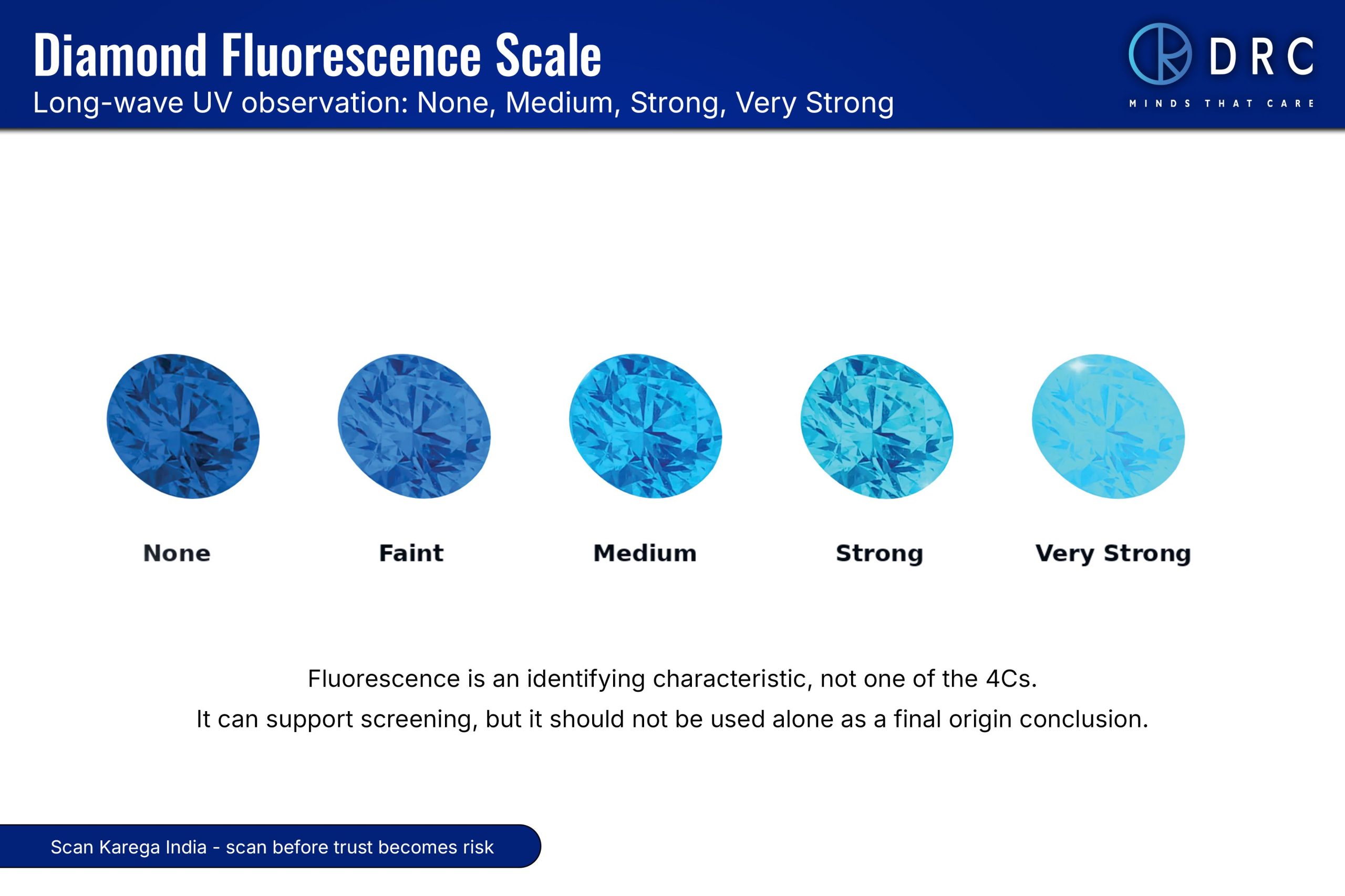
 Some diamonds do not look the same under every light. A diamond may appear normal in office lighting, brighter in daylight, or show a blue glow under ultraviolet light. That glow is called fluorescence.
For customers, fluorescence may sound like a beauty feature. For jewellers, it is more than that. It is a quality, value, disclosure and verification topic. At DRC India, fluorescence is not treated only as a textbook concept. From Katargam, Surat, DRC looks at fluorescence from a practical jeweller’s point of view: what does the stone show under light, and what should the jeweller do before buying, selling, exchanging or certifying? This is where Scan Karega India becomes important.
What is Fluorescence in Diamonds?
Fluorescence is the visible glow a diamond may emit when exposed to ultraviolet light. In many diamonds, this glow appears blue, but it can also appear in other colours depending on the stone.
In gemological reporting, fluorescence is commonly observed under long-wave ultraviolet light. GIA describes diamond fluorescence intensity using levels such as None, Faint, Medium, Strong and Very Strong. Fluorescence is not one of the 4Cs like colour, clarity, cut and carat weight. It is an identifying characteristic that should be observed and communicated properly.
Fluorescence vs Phosphorescence
A simple way to understand the difference is this: fluorescence is the glow while UV light is on. Phosphorescence is the glow that continues briefly after UV light is off.
This difference is important in diamond screening. Fluorescence can be a useful supporting observation, while phosphorescence can be a warning signal in some HPHT-related screening situations. But neither should be treated casually as a final conclusion by itself.
Does Fluorescence Mean a Diamond is Better or Worse?
Not always. Fluorescence does not automatically make a diamond good or bad. Its impact depends on the stone, the intensity of fluorescence, the colour grade, market preference and how the diamond appears to the buyer.
For some diamonds, faint or medium fluorescence may have little visible effect. In some slightly tinted diamonds, blue fluorescence may make the diamond appear visually whiter under certain lighting. In some cases, especially when strong or very strong fluorescence is combined with a hazy or milky appearance, market perception may be affected. A jeweller should avoid one-line answers like fluorescence always reduces value. A better answer is: fluorescence can affect value depending on strength, appearance and market preference.
Why Fluorescence Matters in Diamond Testing
Fluorescence is important because diamond testing often depends on how a stone behaves under specific light conditions. In many natural diamonds, fluorescence may be a normal identifying feature. In laboratory-grown diamonds, fluorescence and related optical responses may also help indicate whether a stone needs deeper screening.
This does not mean fluorescence alone can confirm whether a diamond is natural, CVD-grown or HPHT-grown. It means fluorescence is one signal inside a broader testing process. When short-wave photoluminescence results are confusing or not strongly conclusive, long-wave fluorescence can become an important supporting observation in the total screening workflow.
DRC’s Practical Approach
DRC encourages jewellers not to depend on one clue, one glow or one manual observation. A structured scan-first workflow helps the team observe fluorescence, photoluminescence and phosphorescence behaviour more consistently. Depending on the store’s need, DRC machines such as J Mini Pro, Sentinel, Guardian, J Detect Pro and J Smart Pro can support different levels of retail, loose diamond and mounted jewellery screening.
Final Thought
Fluorescence is not automatically good or bad. It is a diamond behaviour that must be understood in context. For jewellers, the responsibility is to observe it properly, explain it honestly and connect it with a stronger verification process. Scan Karega India means do not let light behaviour become a business blind spot.