
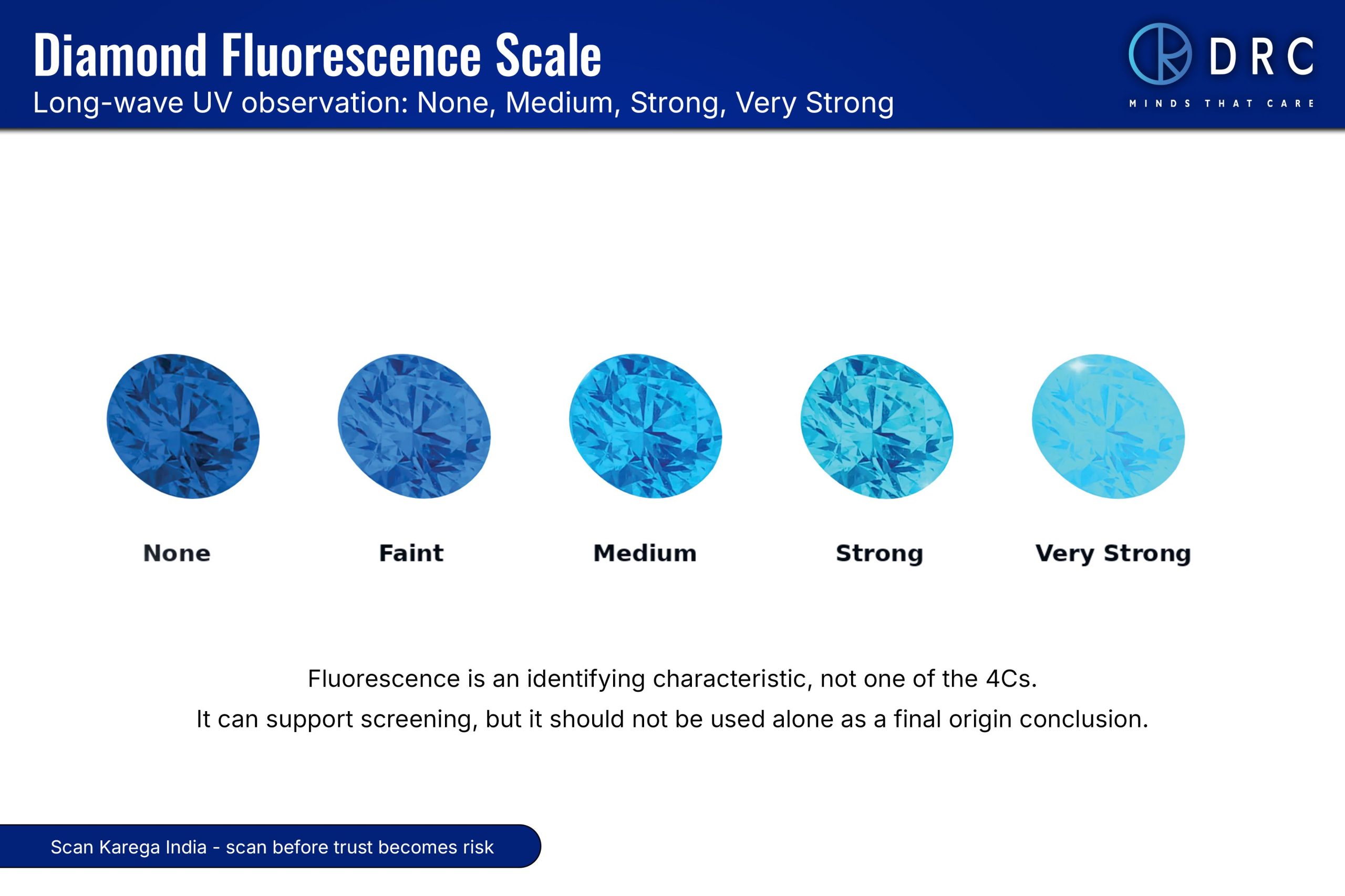
Some diamonds do not look the same under every light.

A diamond may appear normal in office lighting, brighter in daylight, or show a blue glow under ultraviolet light. That glow is called fluorescence.

For customers, fluorescence may sound like a beauty feature. For jewellers, it is more than that. It is a quality, value, disclosure and verification topic.

At DRC India — Diamtech Research Centre, fluorescence is not treated only as a textbook concept. From Katargam, Surat, one of India’s most active diamond manufacturing and jewellery technology hubs, DRC looks at fluorescence from a practical jeweller’s point of view:

What does the stone show under light, and what should the jeweller do before buying, selling, exchanging or certifying?

This is where Scan Karega India becomes important.

A movement to encourage every jeweller, manufacturer and diamond business to scan before they trust, buy, sell, exchange or certify.

What is Fluorescence in Diamonds?

Fluorescence is the visible glow a diamond may emit when exposed to ultraviolet light.

In many diamonds, this glow appears blue, but it can also appear in other colours depending on the stone. GIA explains that fluorescence is not one of the 4Cs like colour, clarity, cut and carat weight. It is an identifying characteristic described on diamond reports by intensity levels such as None, Faint, Medium, Strong and Very Strong.

A simple way to understand it:

Fluorescence is what the diamond does while UV light is on.

This is different from phosphorescence, where the glow may continue briefly even after the light source is removed.

Does Fluorescence Mean a Diamond is Better or Worse?

Not always.

Fluorescence does not automatically make a diamond good or bad. Its impact depends on the stone, the intensity of fluorescence, the colour grade, market preference and how the diamond appears to the buyer.

For some diamonds, fluorescence may have little visible effect. In some cases, blue fluorescence can make a slightly tinted diamond appear visually whiter under certain lighting. In other cases, especially with very strong fluorescence, a diamond may look hazy, oily or milky.

GIA notes that fluorescence is an identifying characteristic rather than a grading factor like the 4Cs, while IGI also discusses how fluorescence can be viewed differently depending on appearance and market perception.

For jewellers, the practical conclusion is simple:

Fluorescence should not be judged casually. It should be observed, explained and documented properly.

Does Fluorescence Affect Diamond Value?

Yes, fluorescence can affect value, but not in one fixed way.

A diamond’s value may be influenced by:

  • Colour grade
  • Clarity
  • Cut quality
  • Carat weight
  • Strength of fluorescence
  • Visible appearance
  • Customer preference
  • Market demand
  • Certification details

A faint or medium fluorescence may not significantly disturb value in many cases. Strong or very strong fluorescence may affect market perception, especially if the stone looks hazy or less transparent.

But jewellers should avoid giving a one-line answer like:

“Fluorescence always reduces value.”

That is not practical or accurate.

A better answer is:

“Fluorescence can affect value depending on how strongly it appears and how it changes the diamond’s visual appearance.”

Why Fluorescence Matters in Diamond Testing

Fluorescence is important because diamond testing often depends on how a stone behaves under specific light conditions.

In natural diamonds, fluorescence may be a normal identifying feature. In laboratory-grown diamonds, fluorescence and related optical responses may also help indicate whether a stone needs deeper screening.

This does not mean fluorescence alone can confirm whether a diamond is natural, CVD-grown or HPHT-grown.

It means fluorescence is one signal inside a broader testing process.

For DRC, this is important because jewellers should not depend on one clue, one glow or one manual observation. They need a structured scan-first workflow.

Where Retail Jewellers Face the Real Fluorescence Challenge

Fluorescence becomes more complicated in daily retail situations.

A jeweller may need to check:

  • A solitaire brought for exchange
  • A ring with multiple mounted stones
  • A bangle with many small diamonds
  • A loose parcel from a supplier
  • A customer’s old jewellery
  • Inventory purchased from different vendors
  • Jewellery being prepared for certification

In these situations, the jeweller is not only asking:

“Does this diamond glow?”

The jeweller is asking:

“Can my team interpret this correctly before the business takes a decision?”

That is why fluorescence should be connected with proper diamond detection, documentation and customer communication.

The Practical Questions Jewellers Ask About Fluorescence

The practical question for jewellers is no longer only:

“What is fluorescence?”

The real questions are:

Does fluorescence affect the value of the diamond I am buying or selling?

Can my staff check fluorescence consistently without depending on guesswork?

Can fluorescence help identify stones that need deeper screening for CVD or HPHT lab-grown diamond risk?

Can one system help scan loose diamonds, mounted jewellery, rings, bangles and parcels?

Can suspected stones be marked on the screen for faster decision-making?

Can a retailer generate a scan report after testing for customer confidence and internal records?

Can the same system also support CZ or moissanite-risk checks, depending on model configuration?

For retailers, the goal is simple:

Do not let light behaviour become a business blind spot.

That is where DRC’s diamond detection machine range becomes central.

DRC’s Approach to Fluorescence-Based Diamond Screening

DRC’s product journey has evolved with the needs of the diamond industry.

One of DRC’s early innovations was:

D-Secure — Launched in 2014
A world-maiden instrument that automatically identifies laboratory-grown diamonds including CVD and HPHT.

After D-Secure, DRC continued expanding its detection ecosystem with:

  • J Mini Pro — launched in 2019
  • J Detect Pro — launched in 2019
  • J Smart Pro — launched in 2019

As market demand increased and businesses needed higher scanning capacity, DRC introduced:

  • Guardian — launched in 2023

The latest product in this detection evolution is:

  • Sentinel — launched in 2025

This evolution matters because fluorescence-related screening is not the same for every business. A boutique jeweller may need a compact retail solution, while an exporter or sourcing office may need larger scanning capacity and stronger workflow discipline.

DRC Machine Best Suitable For Practical Use Case

DRC Machine

Best Suitable For

Practical Use Case

J Mini Pro

Small jewellers, boutique stores and users looking for an affordable starting point

A compact and portable solution for screening small jewellery, selected loose diamonds and regular store-level verification.

Sentinel

Small retailers who need a larger scanning area than J Mini Pro

Suitable for small jewellers who want an affordable retail-level detection machine with the ability to scan bigger jewellery pieces compared to J Mini Pro.

Guardian

Retail jewellers handling bigger jewellery and higher daily scanning volume

Designed for retailers who need an affordable yet compact machine for scanning larger jewellery pieces, multiple items and daily customer-facing verification.

J Detect Pro

Professional users, jewellery offices and loose diamond screening workflows

A Windows-based system suitable for high-volume loose diamond screening, bigger jewellery formats and businesses that may require structured data flow or ERP integration.

J Smart Pro

Exporters, sourcing offices, multi-use retailers and high-volume jewellery businesses

A Windows-based advanced detection system with the highest scanning area, suitable for high-volume scanning of loose diamonds, mounted jewellery and big-size jewellery formats.

The objective is not only to observe fluorescence. The objective is to build a repeatable scan-first workflow before purchase, exchange, certification, dispatch or customer delivery.

That is the heart of Scan Karega India:

Scan before trust becomes risk.

Why Katargam, Surat Gives DRC an Advantage

DRC operates from Katargam, Surat, a location deeply connected with diamond manufacturing, polishing, trading and jewellery technology.

This matters because fluorescence is not only discussed in labs. It is seen in real retail counters, manufacturing units, sourcing offices and trading desks.

Surat gives DRC access to real diamond workflows, helping the brand understand how jewellers actually handle mounted jewellery, loose parcels, exchange stock, customer questions and verification pressure.

This makes DRC’s diamond detection approach practical, not disconnected from daily business.

Final Thought

Fluorescence is not automatically good or bad.

It is a diamond behaviour that must be understood in context.

For jewellers, the real responsibility is to observe it properly, explain it honestly and connect it with a stronger verification process. With J Mini Pro, J Detect Pro, J Smart Pro, Guardian and Sentinel, DRC helps jewellers move from assumption-based checking to scan-supported confidence.

Stay connected with us and All you have to do is follow us here:

Facebook: https://www.facebook.com/DRCPVTLTD

Instagram: https://www.instagram.com/drcpvtltd/

Twitter: https://twitter.com/DRC_Surat

LinkedIn: https://www.linkedin.com/company/drcpvtltd/

Youtube: https://www.youtube.com/channel/UC29N8huo8I-J3WDRZMxLZKA/featured

Contact us

Corporate headquarters:
Plot No. 3, B/S. Kiran Hospital,
Vastadevdi Road, Katargam, Surat
395004, Gujarat, India