
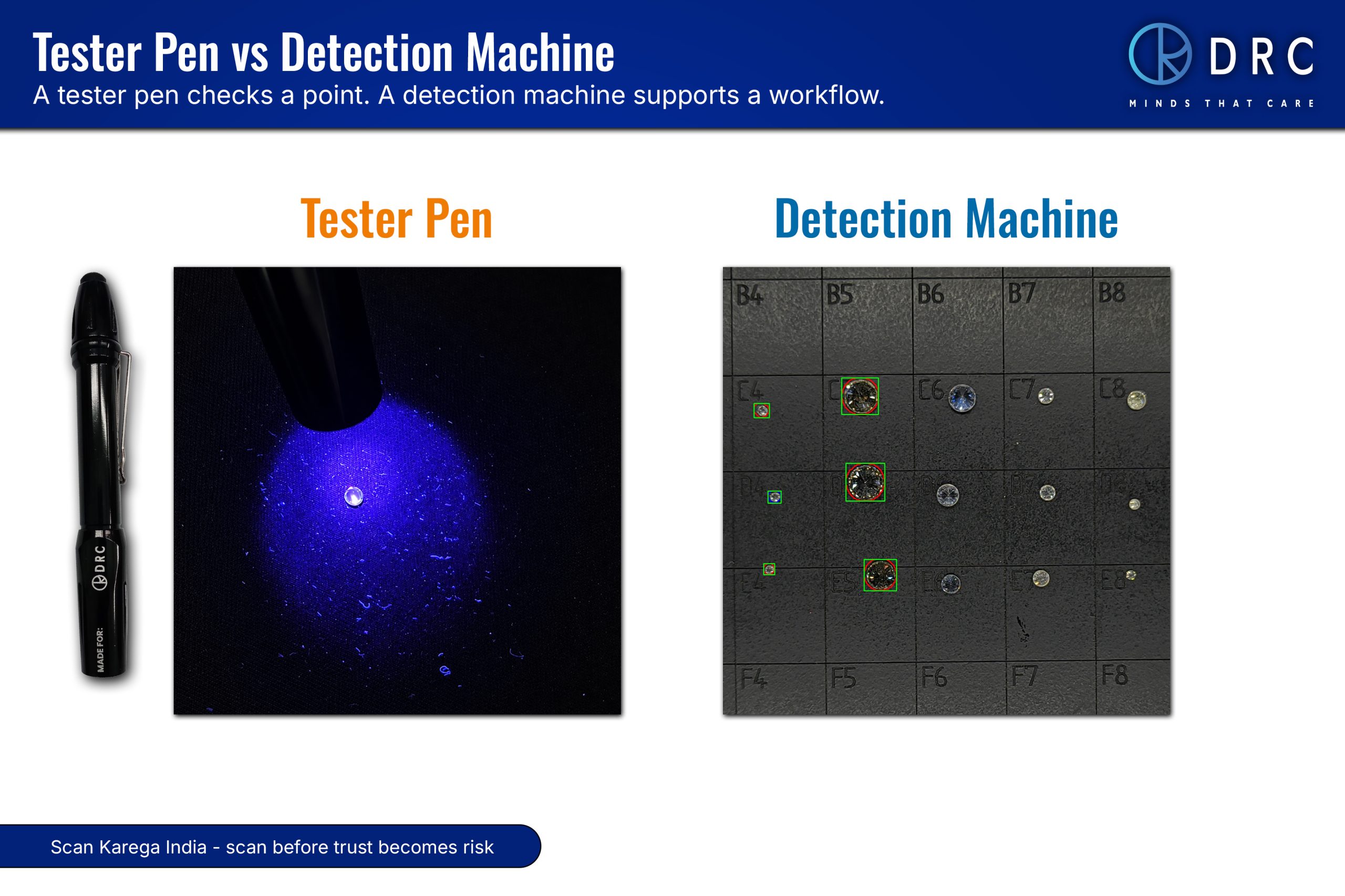
 A diamond tester pen can answer a very limited question. A professional diamond detection machine helps answer a much bigger business question. For jewellers, traders and diamond businesses, this difference matters because the market is no longer dealing only with simple diamond versus non-diamond checks.
Today, retailers may face natural diamonds, CVD-grown diamonds, HPHT-grown diamonds, CZ, moissanite-risk checks, mounted jewellery, loose parcels, melee lots and customer exchange jewellery. So the real question is not: can this tester beep? The real question is: can this system help my team reduce diamond-related business risk before buying, selling, exchanging, certifying or delivering?
What is a Diamond Tester Pen?
A diamond tester pen is a handheld device commonly used for quick basic checks. Many tester pens work by checking properties such as thermal conductivity or electrical conductivity. For a retail counter, it may look convenient because it is small, portable and easy to use.
A tester pen can be useful for a quick first-level check, but it has limitations. It should not be treated as a complete diamond verification system, especially when the jeweller needs to screen CVD-grown diamonds, HPHT-grown diamonds, CZ, moissanite-risk checks or mounted jewellery risks.
What is a Diamond Detection Machine?
A diamond detection machine is a professional screening system designed to help jewellers and diamond businesses evaluate stones more systematically. Depending on the machine model and configuration, it may support CVD-grown diamond screening, HPHT-grown diamond screening, CZ-risk checks, simulant-risk support, loose diamond scanning, mounted jewellery scanning, assisted visual marking and scan report or verification record generation.
A professional diamond detection machine helps reduce dependency on guesswork and supports the store team with a more structured process.
Main Difference in Simple Words
A tester pen checks a point. A detection machine supports a process.
A pen is typically used on one stone at a time and depends heavily on correct manual contact and interpretation. A diamond detection machine supports a wider workflow for loose stones, mounted jewellery, rings, bangles, bracelets and parcels. It can also help the jeweller create internal discipline around scan records, suspected-stone marking and customer-facing confidence.
Why Tester Pens Are Not Enough for Modern Jewellers
A tester pen may be useful for quick checking, but jewellers today face more complex situations: rings with multiple stones, bangles with small diamonds, necklaces with mixed-size stones, loose parcels from suppliers, customer exchange jewellery, old inventory, export or certification-ready goods and melee diamonds in bulk.
In these situations, the risk is not only whether one stone reacts to a pen. The risk is whether the business has a reliable checking process.
Where DRC Machines Fit In
DRC’s diamond detection ecosystem is designed for jewellers, retailers, traders, exporters, sourcing offices and manufacturers who want a more professional scan-first workflow. J Mini Pro can act as a compact starting point. Sentinel and Guardian support broader retail jewellery workflows. J Detect Pro supports professional users and loose diamond screening. J Smart Pro supports advanced and high-volume requirements.
The right choice depends on the jeweller’s actual workflow: jewellery format, scanning area, daily volume, reporting needs and team usability.
Final Thought
A diamond tester pen may have a place in basic checking. But it cannot replace a professional diamond detection machine for modern jewellery businesses dealing with CVD-grown diamonds, HPHT-grown diamonds, CZ, mounted jewellery, loose parcels and customer exchange risks. Scan Karega India means moving from quick checking to scan-supported confidence.