
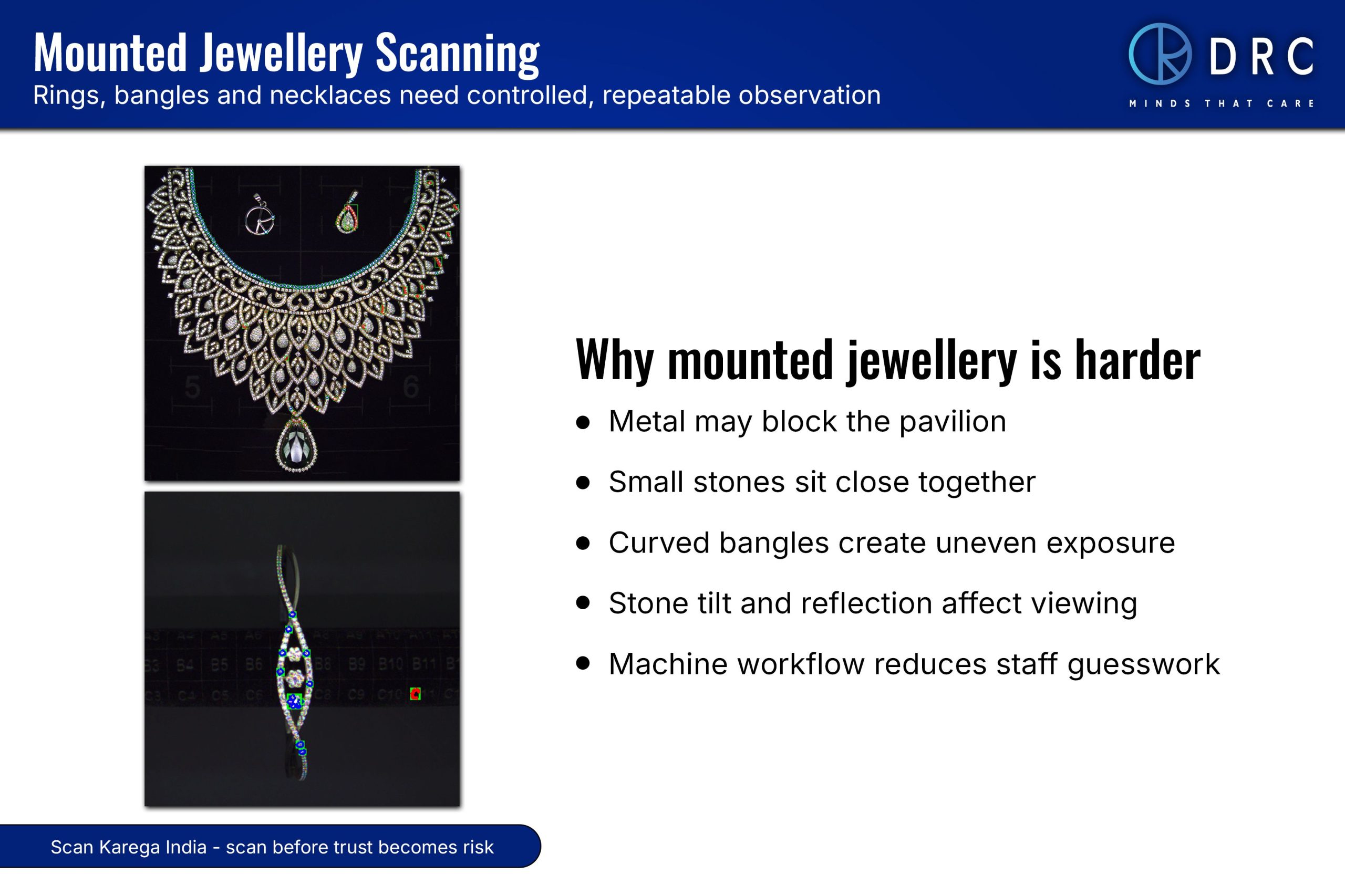
 Mounted jewellery is one of the most difficult places to identify lab-grown diamond risk. A loose stone can be placed properly under a scanner. But in mounted jewellery, the diamond is already set inside a ring, bangle, bracelet, necklace or pendant. The metal setting, design angle, stone size and multiple-stone arrangement can make manual checking difficult.
For jewellers, this is not just a technical challenge. It is a daily retail risk. A customer may bring old jewellery for exchange. A supplier may send finished jewellery. A retailer may receive stock from multiple vendors. In all these cases, the question is simple: can the jewellery be scanned before it is bought, sold, exchanged, certified or delivered? This is where DRC’s Scan Karega India message becomes practical.
Why Mounted Jewellery is Difficult to Check Manually
In mounted jewellery, the diamond is not always fully visible. The pavilion may be hidden, the stone may be tilted, the metal may reflect light, and small melee stones may be placed very close to each other. In bangles and bracelets, curved design can create uneven exposure. In necklaces, multiple sizes and angles may be present in one piece.
This creates practical challenges such as difficult viewing angles, hidden pavilion area, multiple stones in one jewellery piece, small melee diamonds, mixed natural and lab-grown diamond risk, customer exchange jewellery with unknown history and supplier stock from different sources.
What Does Lab-Grown Diamond Risk Mean in Jewellery?
Lab-grown diamond risk means a CVD-grown, HPHT-grown or undisclosed laboratory-grown stone may be present in jewellery where the buyer, seller or customer expects natural diamonds. This can happen in old jewellery exchange, resale jewellery, supplier inventory, repair or remounting cases, finished jewellery purchases and parcels with multiple jewellery items.
For a retailer, even one missed stone can affect customer trust, inventory value and brand reputation. That is why mounted jewellery detection should be treated as a retail workflow, not only a gemology task.
How Can Lab-Grown Diamonds Be Screened in Mounted Jewellery?
Lab-grown diamonds in mounted jewellery can be screened using professional diamond detection machines that support jewellery-format scanning. Depending on the machine and configuration, the system may help evaluate CVD or HPHT indicators, fluorescence response, phosphorescence behaviour, photoluminescence response, CZ and simulant-risk signals, loose and mounted jewellery formats, screen-based suspected-stone marking and scan-record generation.
The goal is not to make retail staff interpret every scientific signal manually. The goal is to create a process where the machine helps the team identify stones that need attention before the jewellery moves ahead in the business cycle.
Which DRC Machine Can Be Considered?
For mounted jewellery, the right DRC machine should be selected based on the size of jewellery, scanning area, daily volume and whether the store needs report generation, assisted marking or advanced workflow features. J Mini Pro can be considered by small jewellers and boutique stores. Sentinel can support retail-level detection needs where a larger scanning area is required compared to compact starting machines. Guardian can be considered by retail jewellers handling bigger jewellery pieces and higher daily scanning. J Detect Pro suits professional users and jewellery offices. J Smart Pro can be considered for exporters, sourcing offices and high-volume businesses.
Where Mounted Jewellery Scanning Helps Most
Mounted jewellery scanning is useful before buying jewellery from a supplier, accepting customer exchange jewellery, selling high-value jewellery, sending jewellery for certification, delivering jewellery to a customer, processing repair or remounting work, checking old inventory and verifying mixed-stone jewellery.
Scan before buying. Scan before selling. Scan before exchange. Scan before certification. Scan before delivery. That is Scan Karega India as a retail habit.
Final Thought
In the jewellery business, trust is not built only by words. It is built by process. A scan-first process helps jewellers protect customer confidence, store reputation, inventory value, supplier accountability, exchange transparency and certification readiness.