
 For jewellers, the difference between CVD and HPHT diamonds is no longer just a gemology topic. It is a daily business risk. A customer may bring jewellery for exchange. A supplier may send mixed stock. A retailer may receive mounted jewellery, loose parcels or melee lots from multiple sources. In all these situations, the jeweller’s responsibility is clear: know what you are buying, selling, exchanging, certifying or delivering.
Both CVD and HPHT are laboratory-grown diamond processes. They are not naturally mined. Because stones grown through these processes can appear very close to natural diamonds in regular viewing conditions, jewellers cannot depend only on eyesight, trust, experience or basic tester pens. This is exactly why DRC India promotes Scan Karega India – scan before trust becomes risk.
What is a CVD Diamond?
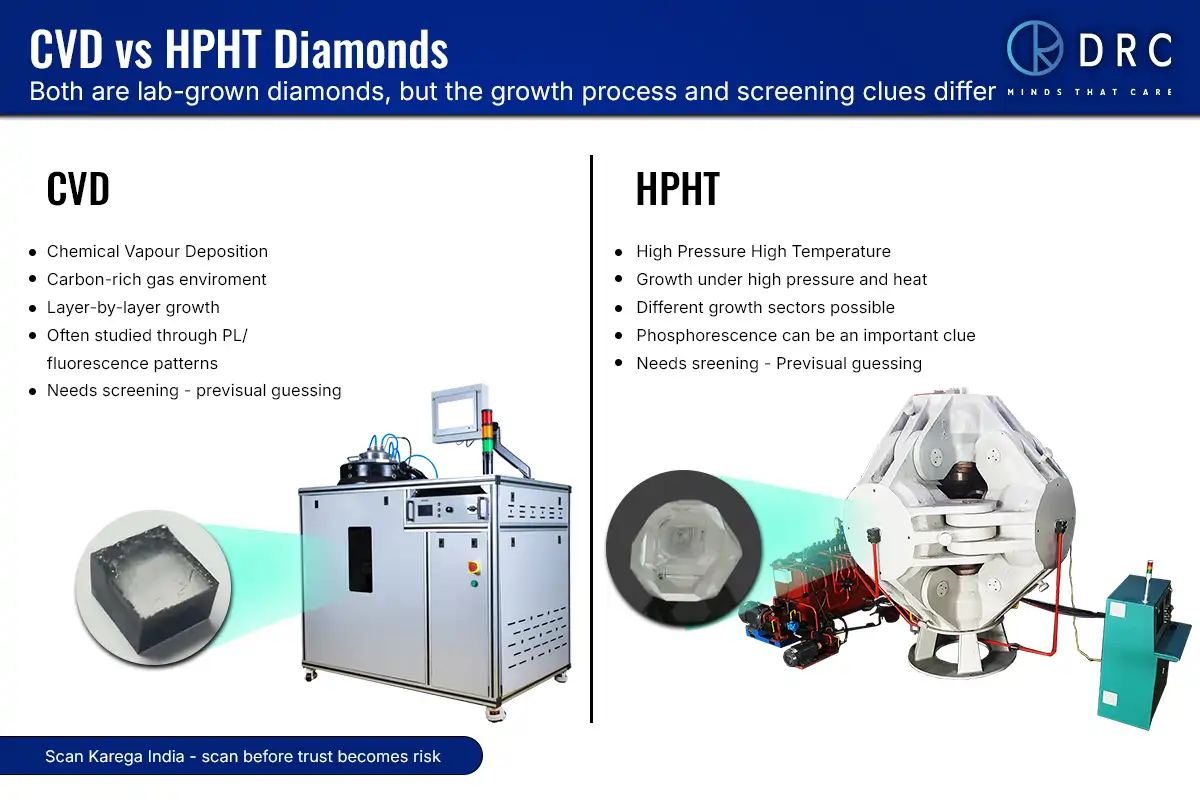
CVD stands for Chemical Vapour Deposition. In this process, diamond growth happens inside a controlled laboratory environment using carbon-rich gases. The stone grows layer by layer under specific conditions. The outcome is a laboratory-grown diamond, not a naturally mined diamond.
For jewellers, CVD detection matters because CVD-grown diamonds may enter the market in loose form, mounted jewellery, rings, bangles, bracelets or mixed parcels. In many cases, the difference may not be visible through normal checking.
What is an HPHT Diamond?
HPHT stands for High Pressure High Temperature. In this process, diamond growth happens under controlled high-pressure and high-temperature conditions. The outcome is also a laboratory-grown diamond, not a naturally mined diamond.
HPHT-grown diamonds may show different optical behaviour compared to CVD-grown diamonds. One commonly discussed behaviour is phosphorescence, where some stones may continue to glow briefly after a light source is removed.
CVD vs HPHT: Practical Difference for Jewellers
The real question for a jeweller is not only: how was this stone grown? The real question is: can my team identify the risk before the stone reaches the customer?
CVD diamonds are commonly discussed for layer-by-layer growth behaviour, fluorescence or photoluminescence response, and growth-related indicators. HPHT diamonds are commonly discussed for high pressure and high temperature growth, growth-sector behaviour, fluorescence patterns and phosphorescence response. In both cases, manual visual checking is not enough for a professional business workflow.
Simple Comparison Table
Point of Difference | CVD Diamond | HPHT Diamond |
Full Form | Chemical Vapour Deposition | High Pressure High Temperature |
Growth Method | Layer-by-layer growth in a controlled gas environment | Growth under high pressure and high temperature |
Common Screening Focus | Growth patterns, fluorescence and photoluminescence response | Phosphorescence, fluorescence and growth-sector indicators |
Manual Detection Challenge | May not be visible through normal checking | May not be visible through normal checking |
Business Need | Machine-led CVD screening | Machine-led HPHT screening |
Why Basic Tester Pens Are Not Enough
A basic diamond tester pen may help in limited checking situations, but it does not become the final answer for CVD vs HPHT separation. A jeweller may need to check loose diamonds, mounted jewellery, rings, bangles, bracelets, necklaces, melee parcels, customer exchange jewellery, supplier stock and export-ready goods.
In these situations, manual checking creates dependency on operator experience. It also increases the chance of inconsistent decisions between staff members. For DRC, the objective is not to replace knowledge. The objective is to reduce guesswork.
DRC Machine Selection for CVD and HPHT Screening
DRC’s detection range includes J Mini Pro, Sentinel, Guardian, J Detect Pro and J Smart Pro. The right machine should be selected based on actual workflow: jewellery format, scanning area, daily volume, need for assisted marking, report requirement, loose diamond usage and staff usability.
A small jeweller may need a compact retail machine. A retail store may need a larger scanning area for mounted jewellery. A professional office or exporter may need higher-volume screening and stronger workflow discipline. The purpose is the same: Scan Karega India – scan before buying, selling, exchanging, certifying or delivering.
Final Thought
CVD vs HPHT is not only a comparison. It affects customer trust, disclosure responsibility, inventory value, supplier confidence, certification readiness and retail reputation. A scan-first workflow helps jewellery businesses move from assumption-based checking to machine-supported confidence.