
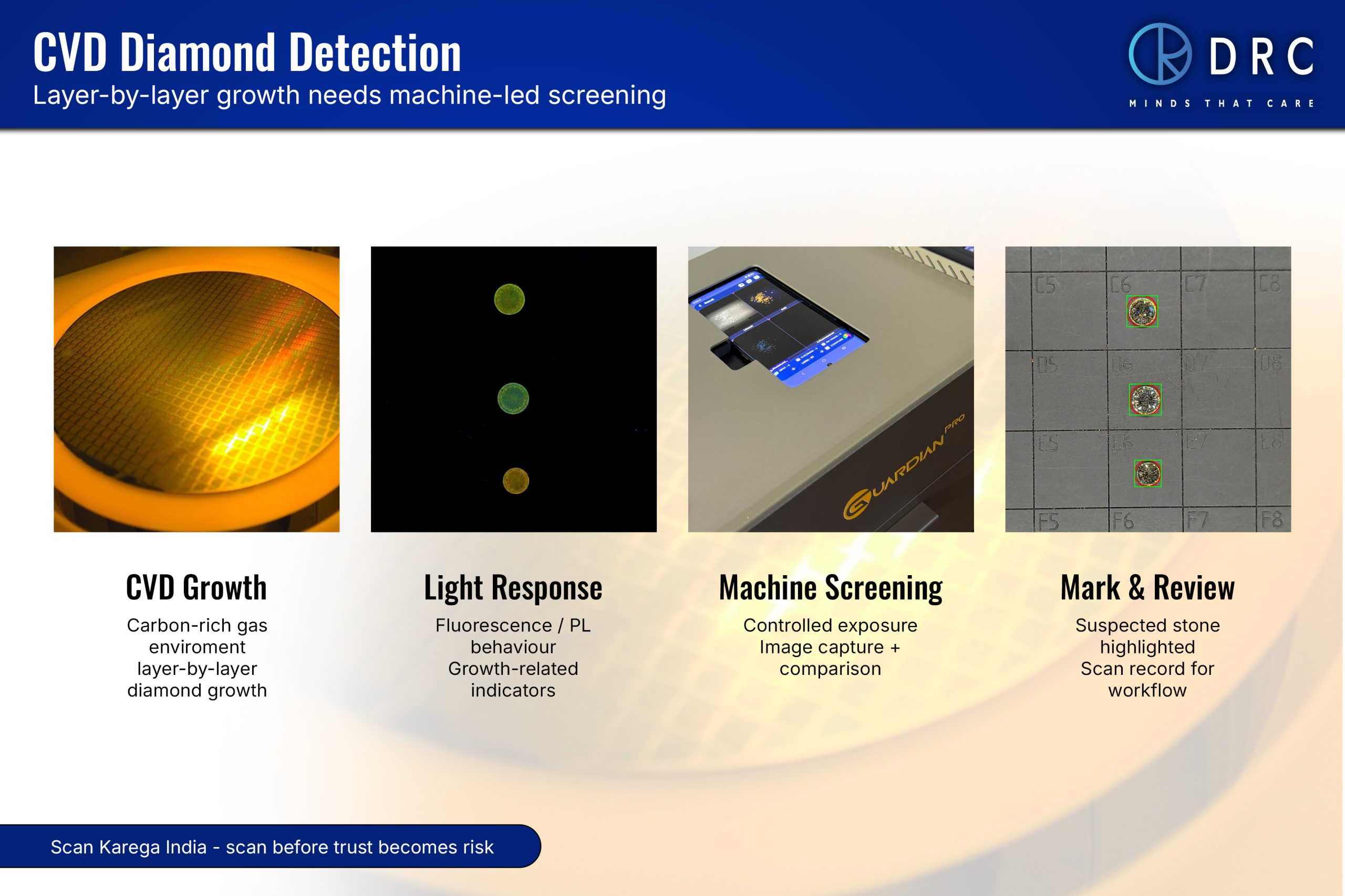
 CVD diamonds are one of the biggest reasons jewellers, traders and diamond manufacturers now need professional diamond detection systems. A CVD diamond is a laboratory-grown diamond produced through the Chemical Vapour Deposition process. It is not naturally mined, but it is still diamond material. Because the appearance can be very close to a natural diamond, visual checking, experience-based judgement and basic tester pens are not enough for reliable business-level verification.
For DRC India – Diamtech Research Centre, this is not only a technical subject. It is a trust subject. From Katargam, Surat, one of India’s most active diamond manufacturing and jewellery technology hubs, DRC India has built a product ecosystem to help jewellers and diamond businesses screen CVD, HPHT, CZ and other diamond-related risks with more confidence. This is the idea behind Scan Karega India: scan before trust, purchase, exchange, certification or customer delivery becomes a business risk.
What Does CVD Mean in Diamond Testing?
CVD stands for Chemical Vapour Deposition. In this process, diamond growth takes place in a controlled laboratory environment using carbon-rich gases. The diamond grows layer by layer under specific conditions. The final result may look like a natural diamond, but its origin is laboratory-grown.
For a customer, this may be a buying preference. For a jeweller, it is a disclosure responsibility. For a manufacturer, it is a quality-control requirement. For a trader, it is a risk-management step. This is why CVD diamond detection machines are becoming essential in jewellery stores, diamond offices, grading workflows and manufacturing units.
Why CVD Diamonds Are Difficult to Detect Manually
A CVD-grown diamond may not reveal itself through normal showroom lighting or a loupe. The challenge becomes bigger when stones are already mounted in rings, bangles, bracelets or necklaces, mixed in loose parcels, present in melee lots, received from multiple suppliers, or brought by customers for exchange.
Because lab-grown diamonds can share many properties with natural diamonds, a basic tester pen cannot become the final protection layer for a jeweller. It may help in a limited first-level check, but it cannot reliably answer the origin question: natural, CVD-grown or HPHT-grown.
How Can a CVD Diamond Be Detected?
A CVD diamond is detected by studying how the stone behaves under controlled testing conditions. Professional screening systems may evaluate fluorescence response, photoluminescence behaviour, phosphorescence behaviour, growth-related indicators, CZ or simulant-risk signals, and the way the stone appears in loose or mounted jewellery formats.
For a jeweller, the important question is not only: What is happening scientifically? The practical question is: can my team scan the diamond before it becomes a business problem? A structured scan-first workflow helps reduce guesswork and makes the checking process more repeatable between different staff members.
Where DRC Fits In
DRC’s diamond detection range supports jewellers, retailers, traders, exporters, sourcing offices and manufacturers with different workflow needs. J Mini Pro can be considered for compact counter-level screening. Sentinel can support retail jewellers who need a larger scanning area than an entry-level machine. Guardian is suitable for retail stores handling bigger jewellery pieces and higher daily scanning volume. J Detect Pro supports professional loose diamond and office workflows. J Smart Pro is suitable for advanced high-volume users requiring a larger scanning area and stronger workflow discipline.
The goal is not only to identify CVD risk. The goal is to create a habit: scan before buying, scan before selling, scan before exchange, scan before certification, and scan before delivery. That is the heart of Scan Karega India.
Final Thought
CVD detection is no longer only a laboratory topic. It is part of daily jewellery business protection. One missed undisclosed lab-grown diamond can affect customer trust, inventory value, supplier confidence and brand reputation. With a scan-first workflow supported by DRC diamond detection machines, jewellers can move from assumption-based checking to machine-supported confidence.