
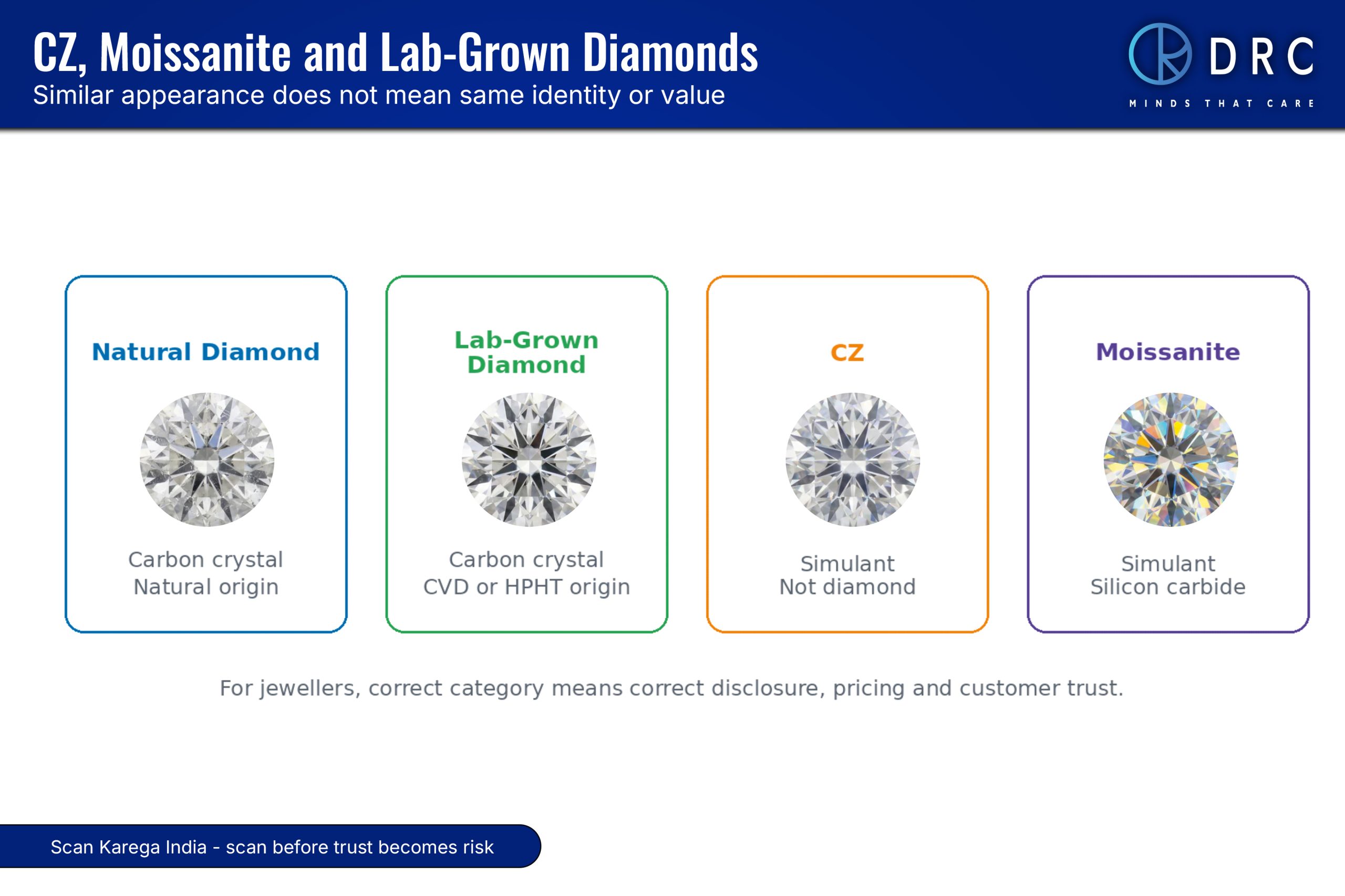
 Not every stone that looks like a diamond belongs to the same category. For jewellers, this difference is extremely important. A customer may ask whether a stone is natural, laboratory-grown, CZ or moissanite. A supplier may send mixed stock. A retailer may receive old jewellery for exchange. A mounted jewellery piece may contain multiple stones from different sources.
In all these situations, confusion can create business risk. CZ, moissanite and lab-grown diamonds are different categories. They may look similar in jewellery, but they are not the same in composition, value, disclosure or customer expectation. This is exactly why jewellers need a scan-first process through Scan Karega India.
What is CZ?
CZ stands for Cubic Zirconia. It is a diamond simulant. That means it is made to look like a diamond, but it is not a diamond. CZ is usually much lower in value compared to natural diamonds and laboratory-grown diamonds. It can look bright and attractive, especially to customers who are not trained, but its identity and value are different.
For jewellers, CZ-risk matters because even one undisclosed simulant in jewellery can affect trust, pricing and disclosure.
What is Moissanite?
Moissanite is another diamond simulant. It is not the same as CZ, and it is not the same as a laboratory-grown diamond. Moissanite is commonly associated with silicon carbide and has its own optical behaviour, brilliance and market category.
Moissanite may sometimes confuse customers because it can appear very bright and diamond-like. In basic checks, some stones may create confusion if the jeweller depends only on limited testing tools.
What is a Lab-Grown Diamond?
A lab-grown diamond is created in a laboratory through processes such as CVD or HPHT. It is not naturally mined, but it is diamond material. For jewellers, the important issue is disclosure. If a customer expects a natural diamond, then a CVD-grown or HPHT-grown diamond must not be mixed or sold without correct identification and communication.
This is why jewellers need to distinguish between natural diamonds, CVD-grown diamonds, HPHT-grown diamonds, CZ, moissanite and other simulant risks.
Simple Category Difference
Natural diamond means diamond formed naturally. CVD and HPHT are lab-grown diamonds, so they are diamonds by material but different by origin. CZ and moissanite are simulants, so they may look like diamonds but are not diamonds.
For the jeweller, the responsibility is not only to know these categories. The responsibility is to verify them before business decisions.
Why Visual Checking is Not Enough
CZ, moissanite and lab-grown diamonds can create confusion in daily retail situations. A jeweller may need to check rings, bangles, bracelets, necklaces, loose stones, melee parcels, old customer jewellery, supplier stock and exchange jewellery.
In mounted jewellery, the challenge becomes bigger because stones are already set inside metal. The viewing angle may be restricted, and small stones can be difficult to examine manually. That is why jewellery stores need more than eyesight and basic tools. They need a repeatable screening process.
How DRC Supports Simulant-Risk and Lab-Grown Screening
DRC’s diamond detection range supports jewellers and diamond businesses that need structured screening for CVD, HPHT, CZ and other diamond-related risks, depending on model configuration and testing workflow. For compact retail needs, J Mini Pro can support small jewellers and boutique stores. Sentinel and Guardian can support broader jewellery-format workflows. J Detect Pro can be considered for professional users and loose diamond screening. J Smart Pro can support advanced high-volume scanning requirements.
The purpose is not only to identify a stone category. The purpose is to protect the transaction.
Final Thought
Customers may not know the technical differences between CZ, moissanite, CVD and HPHT. But they know when they feel misled. In jewellery, similar appearance should never replace correct identification. Scan Karega India means scanning before similar-looking stones create different-value mistakes.