
 Melee diamonds are small, but the risk in bulk parcels can be large. A single parcel may contain hundreds or thousands of tiny diamonds. These stones may move through manufacturers, traders, exporters, jewellery units and retailers before they are finally set into jewellery. When the volume is high, manual checking becomes slow, inconsistent and risky.
This blog focuses on measurement and sorting workflow for melee diamonds. Lab-grown diamond risk screening is also important, but measurement and sorting are a separate quality-control requirement. For DRC India, scanning is a broader business discipline: scan before buying, sorting, manufacturing, dispatch or customer delivery.
What Are Melee Diamonds?
Melee diamonds are small diamonds commonly used in jewellery designs such as rings, bangles, bracelets, necklaces, pendants and watches. Because they are small and often handled in bulk, melee diamonds create practical challenges: large quantity per parcel, similar size appearance, difficult manual checking, sorting errors, mixed parcel risk, time-consuming inspection, quality-control pressure and manufacturing delays.
For jewellers and manufacturers, the problem is not only identifying one stone. The real challenge is handling the entire parcel accurately and efficiently.
Why Bulk Parcel Measurement is Difficult
Bulk parcels are difficult because they combine volume, speed and accuracy pressure. A team may need to check size consistency, stone count, shape or measurement differences, quality-control sorting, manufacturing readiness, export or dispatch accuracy and internal records.
Manual processes can become slow and dependent on human attention. In high-volume operations, even small mistakes can create rework, wastage, customer complaints or production delays.
How to Build a Better Melee Workflow
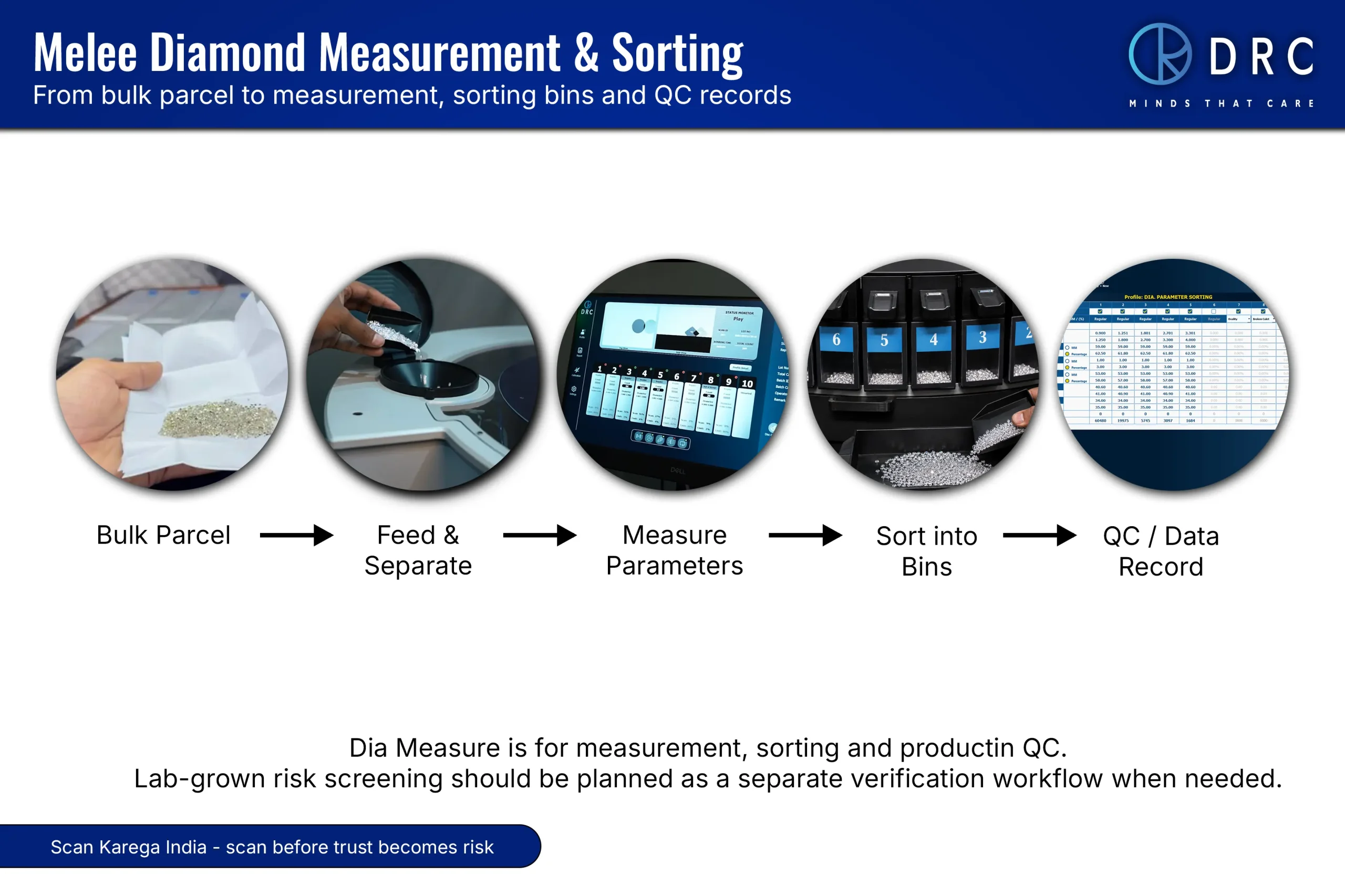
A proper melee diamond workflow should include three steps. First, pre-screen the parcel for obvious inconsistencies and confirm supplier documentation. Second, use machine-led measurement and sorting to reduce dependency on manual sieves and visual judgement. Third, maintain QC data, images or reports for internal tracking and future reference.
This approach improves consistency before diamonds enter jewellery manufacturing. It also helps production teams reduce rechecking and avoid size mismatch during setting.
Where Dia Measure Fits In
Dia Measure is DRC’s diamond measurement and automatic sorting solution for businesses that handle loose diamonds and melee parcels. Depending on configuration, it can support measurement-based sorting by checking parameters such as diameter, total height, table size, crown angle, pavilion angle and girdle height. It is relevant for diamond manufacturers, jewellery manufacturers, sorting departments, QC teams, export units, sourcing offices and traders handling loose parcels.
Instead of depending only on manual sieves and visual judgement, businesses can move toward automated measurement and sorting discipline.
Why Manual Sorting Alone is Not Enough
Manual sorting has been used for years, but modern production needs higher consistency. Manual methods may face operator fatigue, human error, inconsistent sizing judgement, slow productivity, repeated rechecking, difficulty in handling large volumes and limited reporting discipline.
In jewellery manufacturing, size mismatch can affect setting quality, design consistency and production speed. A machine-led approach helps reduce these workflow gaps.
Final Thought
Most people think scanning is only for lab-grown diamond detection. For DRC, scanning is a wider habit. In melee parcels, it means measuring, sorting and checking before small errors become larger operational problems. That is the practical meaning of Scan Karega India for manufacturers and jewellery production teams.